Debugging the Ghost in the Browser: Resolving a BrowserOS MCP Sidecar Crash & Migration Desync
When working with autonomous AI coding agents, one of the most powerful workflows is delegating web tasks—authentication flows, dashboard verifications, and scraping—to a dedicated agent browser. In my setup on Arch/CachyOS Linux, I rely on BrowserOS Neo connected to Google’s Antigravity CLI (agy) via the Model Context Protocol (MCP).
Everything was running smoothly until a sudden failure stopped the browser tool dead in its tracks:
1
2
✗ browseros-neo error: calling "initialize": sending "initialize": rejected by transport:
  Post "http://127.0.0.1:9010/mcp": dial tcp 127.0.0.1:9010: connect: connection refused
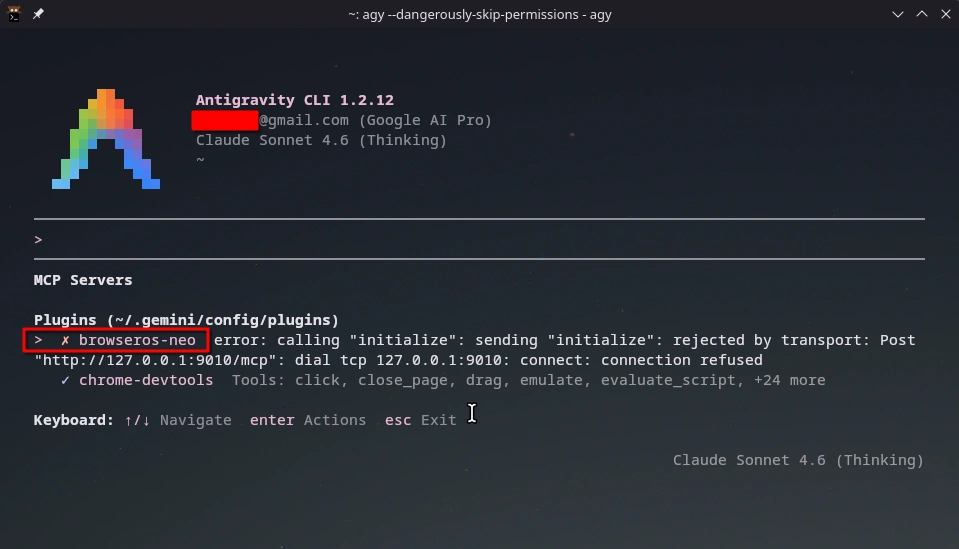
Port 9010 was dead. No matter how many times the browser was launched, agy couldn’t reach the MCP endpoint. What looked like a simple connection timeout turned out to be a fascinating journey through Chromium IPC architecture, Rust SeaORM migration rollbacks, SQLite column collision bugs, and an overly aggressive pre-flight package script.
Here is the deep-dive analysis of what went wrong and how we systematically diagnosed, repaired, and permanently resolved it through methodical pair-debugging with AI.
1. Architecture: How BrowserOS MCP Actually Works
To debug why 127.0.0.1:9010 was refusing connections, we first had to trace the plumbing of BrowserOS Neo:
1
2
3
4
5
6
7
8
9
10
11
12
13
14
15
16
┌─────────────────────────┐          HTTP POST /mcp          ┌──────────────────────────────────┐
│   Antigravity CLI (agy) │ ───────────────────────────────> │  BrowserOS Host (browserclaw)    │
│      (MCP Client)       │                                  │  Proxy Port: 0.0.0.0:9010        │
└─────────────────────────┘                                  └──────────────────────────────────┘
                                                                               │
                                                                   Internal IPC / Proxy
                                                                               ▼
┌─────────────────────────┐          CDP ws://:9114          ┌──────────────────────────────────┐
│  Puppeteer / DevTools   │ ───────────────────────────────> │  Rust Sidecar Server             │
│                         │                                  │  (browseros-claw-server)         │
│                         │                                  │  Port: 127.0.0.1:9210            │
└─────────────────────────┘                                  └──────────────────────────────────┘
                                                                               │
                                                                         SeaORM / SQLite
                                                                               ▼
                                                             ~/.browserclaw/browserclaw.sqlite
browserclaw(Chromium application): Acts as the parent process and opens port9010as a public HTTP proxy.browseros-claw-server(Rust sidecar): A background daemon spawned by Chromium that binds to127.0.0.1:9210, managing sessions, state, and tool dispatch.browserclaw.sqlite: Stores persistent sessions, tab metadata, and tracks schema migrations using SeaORM.
If the Rust sidecar fails to start or crashes, Chromium attempts 5 connection retries before giving up:
1
[ERROR:browseros_server_manager.cc:1058] browseros: Bundled server unavailable; stopping sidecar
When the sidecar stops, Chromium immediately tears down the port 9010 proxy, leaving the MCP client with connection refused.
2. Digging Into the Logs: The Crash Sequence
Checking journalctl --user and ~/.browserclaw/logs/claw-server.log revealed the initial smoking gun:
1
2
3
4
5
6
7
2026-09-29T07:15:23Z INFO sea_orm_migration::migrator: Applying all pending migrations
2026-09-29T07:15:23Z INFO sea_orm_migration::migrator: Applying migration 'm0017_add_run_error_budget'
2026-09-29T07:15:23Z INFO sea_orm_migration::migrator: Migration 'm0017_add_run_error_budget' has been applied
2026-09-29T07:15:23Z INFO sea_orm_migration::migrator: Applying migration 'm0018_add_feedback_invite'
2026-09-29T07:15:23Z INFO sea_orm_migration::migrator: Migration 'm0018_add_feedback_invite' has been applied
2026-09-29T07:15:23Z INFO sea_orm_migration::migrator: Applying migration 'm0019_add_feedback_invite_dismissal'
Error: Execution Error: error returned from database: (code: 1) duplicate column name: dismissed_at_ms
Immediately followed 5 seconds later by:
1
2
3
4
5
2026-09-29T07:15:28Z INFO sea_orm_migration::migrator: Applying all pending migrations
Error: Custom Error: Migration file of version 'm0017_add_run_error_budget' is missing,
this migration has been applied but its file is missing
Migration file of version 'm0018_add_feedback_invite' is missing,
this migration has been applied but its file is missing
Two different binaries were conflicting over the exact same SQLite database.
3. Root Cause Analysis: The Two-Binary Trap
Trapped Between Two Versions
By inspecting _EXE metadata across journal entries, we found that BrowserOS maintains two different server binaries:
- The System Bundled Server (
v0.0.57):/usr/lib/browserclaw/BrowserClawServer/default/resources/bin/browseros-claw-serverCompiled with migrations only up tom0016_add_task_summary. - The Auto-Updated Server (
v0.0.59):~/.config/browser-claw/.browseros/BrowserClawServer/versions/0.0.59/resources/bin/browseros-claw-serverCompiled with newer migrationsm0017,m0018, andm0019.
The Fatal Migration Loop
- When BrowserOS launched, it downloaded the updated server
0.0.59. - On startup/shutdown,
0.0.59ran pending SeaORM migrations:m0017_add_run_error_budget: Created tablerun_error_budget(Success).m0018_add_feedback_invite: Created tablefeedback_invite(Success).m0019_add_feedback_invite_dismissal: AttemptedALTER TABLE feedback_invite ADD COLUMN dismissed_at_ms.
- The Column Collision: The
feedback_invitetable on disk already had thedismissed_at_mscolumn from an earlier partial migration attempt. In SQLite, adding an existing column triggers a hard fatal error:duplicate column name: dismissed_at_ms. - Because migration
m0019aborted,0.0.59failed to boot. BrowserOS detected the failure and rolled back to the bundled fallback server (v0.0.57). - SeaORM Integrity Panic: When the fallback server booted, it queried
SELECT version FROM seaql_migrations;. It sawm0017andm0018recorded in the database, but since those migrations were written afterv0.0.57was compiled, SeaORM threw:Migration file of version 'm0017_add_run_error_budget' is missingand aborted immediately.
The Rogue Doctor Script
To make matters worse, the AUR package for browseros-neo-bin had bundled a wrapper script (/usr/lib/browserclaw/browseros-neo-doctor.sh) designed to run before every browser launch:
1
2
3
4
5
6
7
8
9
# From browseros-neo-doctor.sh
rm -rf "$LOCK_DIR/versions" 2>/dev/null || true

sqlite3 "$DB" "SELECT version FROM seaql_migrations;" | while read -r v; do
  strings "$BIN" | grep -aFq "$v" || {
    echo "removing unknown migration $v"
    sqlite3 "$DB" "DELETE FROM seaql_migrations WHERE version='$v';"
  }
done
The script:
- Forcefully wiped
versions/on every boot, deletingv0.0.59. - Checked
stringsonly on the old bundled binary, deleting valid migrations from the database. - And checked the wrong directory for
server.lock(.../BrowserClawServer/server.lockinstead of.../.browseros/server.lock), leaving stale 0-byte lock files behind.
4. The Clean, Permanent Fix
Instead of band-aid workarounds, we engineered a durable, surgical fix in three steps:
Step 1: Repair the Database Schema
Since feedback_invite was empty (0 rows), we dropped it completely and cleared the dangling migration entries so the migrator could rebuild it cleanly:
1
2
3
4
5
6
7
8
sqlite3 ~/.browserclaw/browserclaw.sqlite "
  DROP TABLE IF EXISTS feedback_invite;
  DELETE FROM seaql_migrations WHERE version IN (
    'm0017_add_run_error_budget',
    'm0018_add_feedback_invite',
    'm0019_add_feedback_invite_dismissal'
  );
"
Step 2: Remove Stale Lock Files
1
rm -f ~/.config/browser-claw/.browseros/server.lock
Step 3: Implement an Intelligent User-Space Wrapper
We created ~/.local/bin/browserclaw (which has priority in PATH over /usr/bin):
1
2
3
4
5
6
7
8
9
10
11
12
13
14
15
16
17
18
19
20
21
22
23
24
25
26
27
28
29
30
31
32
33
#!/usr/bin/env bash
# BrowserOS / BrowserClaw wrapper with robust pre-flight repair.
set -euo pipefail

DB="${HOME}/.browserclaw/browserclaw.sqlite"
LOCK_DIR="${HOME}/.config/browser-claw/.browseros"
FALLBACK_LOCK_DIR="${LOCK_DIR}/BrowserClawServer"

# 1. Clean up stale server.lock files if process is dead or lock is empty
for lfile in "${LOCK_DIR}/server.lock" "${FALLBACK_LOCK_DIR}/server.lock"; do
  if [[ -f "$lfile" ]]; then
    _pid=$(tr -d '[:space:]' < "$lfile" 2>/dev/null || true)
    if [[ -z "$_pid" ]] || ! kill -0 "$_pid" 2>/dev/null; then
      rm -f "$lfile" 2>/dev/null || true
    fi
  fi
done

# 2. Prevent m0019 duplicate column collision from breaking startup
if [[ -f "$DB" ]]; then
  _has_m0019=$(sqlite3 "$DB" "SELECT count(*) FROM seaql_migrations WHERE version='m0019_add_feedback_invite_dismissal';" 2>/dev/null || echo "0")
  if [[ "$_has_m0019" == "0" ]]; then
    _fi_exists=$(sqlite3 "$DB" "SELECT count(*) FROM sqlite_master WHERE type='table' AND name='feedback_invite';" 2>/dev/null || echo "0")
    if [[ "$_fi_exists" != "0" ]]; then
      sqlite3 "$DB" "DROP TABLE IF EXISTS feedback_invite;" 2>/dev/null || true
      sqlite3 "$DB" "DELETE FROM seaql_migrations WHERE version IN ('m0018_add_feedback_invite');" 2>/dev/null || true
    fi
  fi
fi

# 3. Preserve auto-updated versions and execute real browser
export LD_LIBRARY_PATH="/usr/lib/browserclaw${LD_LIBRARY_PATH:+:$LD_LIBRARY_PATH}"
exec /usr/lib/browserclaw/browserclaw "$@"
We also created ~/.local/share/applications/browserclaw.desktop pointing to ~/.local/bin/browserclaw so that launching BrowserOS from the KDE Plasma application menu uses the wrapper seamlessly.
5. Verification & Live Confirmation
Upon launching BrowserOS with the new wrapper, the sidecar logs immediately confirmed success:
1
2
3
4
INFO sea_orm_migration::migrator: Migration 'm0017_add_run_error_budget' has been applied
INFO sea_orm_migration::migrator: Migration 'm0018_add_feedback_invite' has been applied
INFO sea_orm_migration::migrator: Migration 'm0019_add_feedback_invite_dismissal' has been applied
INFO browseros_claw_server_rs: claw-server-rust listening bound=127.0.0.1:9210
All three listening ports came alive:
- Port 9114: Chromium CDP
- Port 9210: Rust Sidecar (
browseros-claw-server) - Port 9010: Chromium MCP Reverse Proxy
Testing the Protocol Handshake
Testing the JSON-RPC handshake against http://127.0.0.1:9010/mcp:
1
2
3
4
curl -X POST http://127.0.0.1:9010/mcp \
  -H "Content-Type: application/json" \
  -H "Accept: application/json, text/event-stream" \
  -d '{"jsonrpc":"2.0","method":"initialize","params":{"protocolVersion":"2024-11-05","capabilities":{},"clientInfo":{"name":"test-client","version":"1.0"}},"id":1}'
1
2
3
4
5
6
7
8
9
10
11
12
13
14
15
{
  "jsonrpc": "2.0",
  "id": 1,
  "result": {
    "protocolVersion": "2024-11-05",
    "capabilities": {
      "tools": { "listChanged": true }
    },
    "serverInfo": {
      "name": "browseros-neo",
      "title": "BrowserOS neo",
      "version": "0.0.59"
    }
  }
}
HTTP 200 OK. serverInfo: 0.0.59.
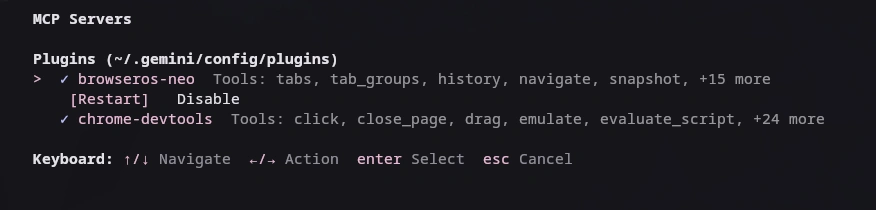
Antigravity CLI Verification
Back in Antigravity CLI, browseros-neo reconnected instantly with green checkmarks, loading all browser action tools:
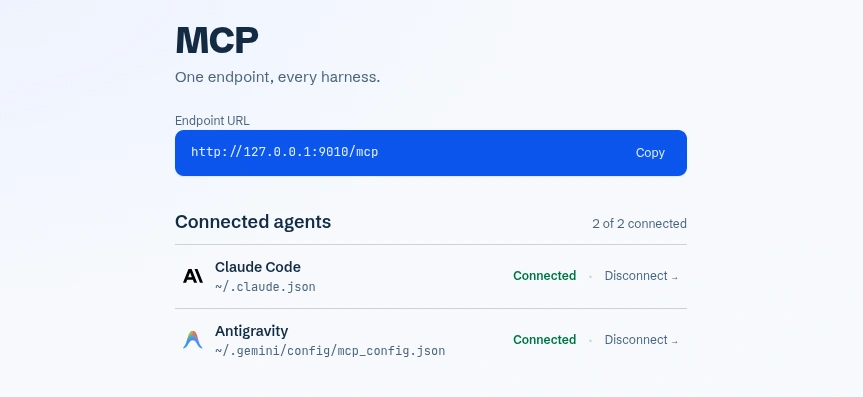
BrowserOS Cockpit Verification
Checking the BrowserOS Neo Cockpit MCP management page confirms both connected agents are paired and active:
Takeaways
- Auto-updates and Embedded Migrations: When a binary auto-updates independently of its parent package manager, schema migrations must be strictly backward-compatible and idempotent. Never assume an
ALTER TABLE ADD COLUMNis safe without checking table definition state. - Be Careful with Package Doctor Scripts: Automated cleanup scripts that grep binary strings or delete cache folders (
versions/) can inadvertently sabotage native update mechanisms. - Trace the Entire Protocol Chain: In modern agentic tools, a single “connection refused” error often spans multiple application layers (CLI client → proxy → sidecar daemon → SQLite database). Methodical logging, process inspection, and AI pair-debugging will always uncover the root cause.