Psychology in Security: Cognitive Biases and Human Heuristics
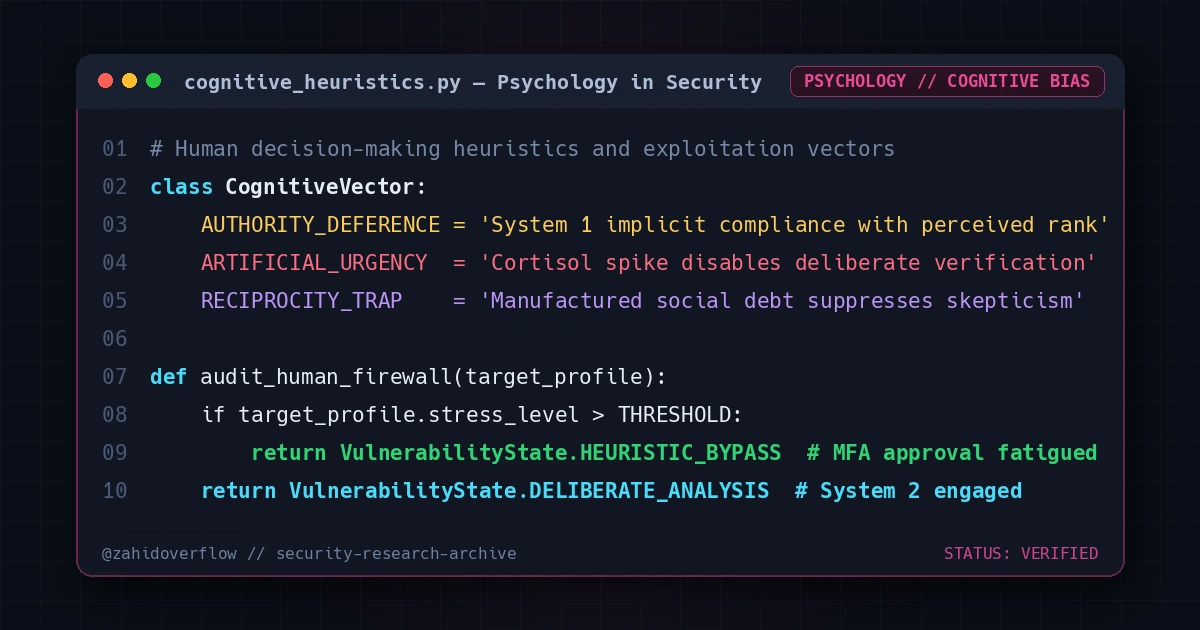
In traditional cybersecurity education, systems are often modeled as networks of firewalls, operating systems, and cryptographic protocols. Yet the most critical processing unit in every infrastructure remains biological: the human brain.
Just as compilers have optimization quirks and software runtimes have memory safety bugs, human cognition relies on mental shortcuts—known as heuristics—which can be predictably manipulated.
1. The Heuristic Shortcut: System 1 vs. System 2
Psychologist Daniel Kahneman famously categorized human cognition into two modes:
- System 1 (Fast, Automatic, Emotional): Operates effortlessly on pattern recognition and intuition.
- System 2 (Slow, Analytical, Deliberate): Handles critical calculation, skeptical review, and deep validation.
Social engineering attacks are engineered to keep victims trapped in System 1. By applying artificial time pressure or manufactured panic, the attacker prevents the target from engaging System 2 analysis.
2. Exploitable Cognitive Biases
Authority and Deference
When presented with perceived seniority or regulatory urgency (e.g., “CISO Office: Immediate Action Required”), humans default to compliance. The cognitive cost of questioning perceived authority is naturally resisted by social conditioning.
Scarcity and Artificial Urgency
“Your session expires in 2 minutes” or “Only 3 spots remaining for system verification”. Urgency triggers an adrenaline response that narrows focus and sidelines critical verification steps like checking domain names or verifying SSL certificates.
The Reciprocity Instinct
Humans have an innate desire to repay kindness or helpful gestures. An attacker who first provides assistance (e.g., helping solve a minor technical issue) establishes social capital, making the victim significantly more likely to grant credential or configuration favors later.
3. Patching the Human Layer
Technical controls—such as hardware FIDO2 keys and automated MFA prompts—are vital precisely because they remove human cognitive fatigue from the authentication equation. Designing resilient systems means acknowledging human psychology rather than blaming people when natural biases are exploited.