Practical Android Hacks: Navigating Root Detection & Integrity APIs
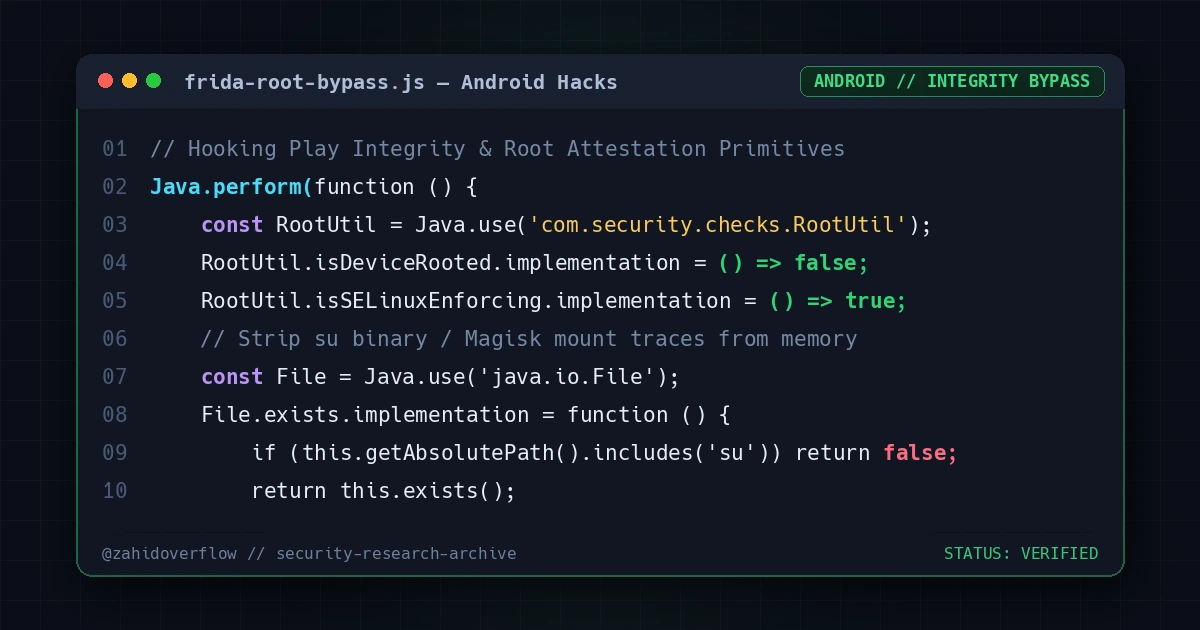
Modern mobile application security is increasingly moving toward client integrity attestation, hardware-backed keystores, and multi-layered anti-tamper mechanisms. For security researchers and penetration testers, understanding how these protections function under the hood is essential for meaningful assessments.
In this practical overview, we explore how contemporary Android applications assess their environment, check for root privileges, and interact with Google’s Play Integrity API.
1. The Anatomy of Modern Root Detections
Early root detection relied on trivial file system checks: searching for /system/app/Superuser.apk or looking for /system/bin/su in $PATH. Modern detection suites implement far more sophisticated heuristics:
- Mount Namespace Checks: Inspecting
/proc/mountsand/proc/self/mountinfofor overlayfs, Magisk mirrors, and hidden mounts. - Prop Inspections: Reading system properties via
__system_property_getforro.build.tags=test-keys,ro.debuggable=1, or specific OEM engineering flags. - SELinux Status: Checking whether SELinux has been switched from
EnforcingtoPermissive. - Process Scanning & Memory Mapping: Looking for injection artifacts (e.g.,
frida-agent.so,substrate, orxposed) in/proc/self/maps.
2. Zygisk and Systemless Masking
With Magisk’s shift toward Zygisk (running code directly in the Android OS zygote process before apps fork), root hiding moved from simple mount unmounting to in-process memory isolation:
1
2
3
# Verify current Zygote injection and module status
adb shell "su -c 'magisk --version'"
adb shell "getprop | grep -E 'build.tags|debuggable'"
By leveraging Zygisk modules such as Shamiko, researchers can enforce strict unmounting of root paths and deny-list isolation for target applications during dynamic testing.
3. Dynamic Instrumentation with Frida
When static patching of APKs triggers signature verification or anti-repackaging checks, in-memory instrumentation via Frida remains the weapon of choice:
1
2
3
4
5
6
7
8
9
Java.perform(function () {
    // Intercept common root-checker utility classes
    var RootChecker = Java.use("com.example.security.RootUtil");

    RootChecker.isDeviceRooted.implementation = function () {
        console.log("[+] RootUtil.isDeviceRooted() hooked - returning false");
        return false;
    };
});
Understanding both sides—how developers implement defensive checks and how security auditors navigate past them—is key to auditing enterprise Android applications effectively.